Market News
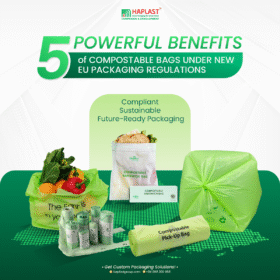
5 Powerful Benefits of Compostable Bags Under New EU Packaging Regulations
As global packaging regulations tighten and sustainability becomes a mandatory business requirement rather than a choice, compostable bags are emerging as a strategic packaging solution for brands worldwide.
In particular, with the EU’s PPWR (Packaging and Packaging Waste Regulation) and increasing plastic reduction policies across North America and Asia-Pacific, businesses are under pressure to adopt compliant and verifiable eco-friendly alternatives. At this stage, compostable packaging is no longer just an “Eco Trend” – it is becoming a market access requirement for many industries.
Here are 5 key benefits of compostable bags that explain why global brands are accelerating the transition.

1. They Directly Address Global Plastic Reduction Regulations

Governments and regulatory bodies are aggressively reducing single-use plastics.
Compostable bags offer a practical solution because they are designed to break down into natural elements under industrial composting conditions, leaving no toxic residue.
This makes them highly relevant in markets such as:
- European Union (PPWR framework)
- United States (state-level plastic bans)
- Australia and parts of Asia
For brands, this means lower regulatory risk and easier market entry in regulated regions.
2. They Support Compliance with EU PPWR and ESG Requirements
Under PPWR, packaging must meet stricter rules on:
- Recyclability and material transparency
- Reduction of virgin plastic usage
- Lifecycle environmental impact reporting
- Supply chain traceability
While recycling is prioritized in many cases, compostable packaging plays a critical role in organic waste streams and hard-to-recycle applications.
Certified compostable bags (EN 13432, OK Compost, ASTM D6400) help brands:
- Demonstrate compliance readiness
- Meet ESG reporting expectations
- Improve sustainability ratings from buyers and retailers
3. They Solve Real Waste Management Challenges
One of the biggest issues in modern waste systems is contamination in recycling streams.
Compostable bags are especially useful in:
- Organic food waste collection
- Retail produce packaging
- Pet waste disposal
- Municipal waste separation programs
In these applications, compostable materials help reduce sorting complexity and improve waste processing efficiency.
This is one of the most practical benefits of compostable bags in real-world city infrastructure.
4. They Are Increasingly Required by Global Buyers
Across FMCG, retail, and food industries, procurement requirements are shifting.
Buyers now evaluate suppliers based on:
- Certification validity (EN 13432, OK Compost, BPI)
- Material transparency
- Export compliance capability
- ESG alignment
As a result, compostable packaging is becoming a standard procurement requirement, not an optional upgrade.
Brands without certified sustainable packaging risk losing access to key retail and export channels.
5. They Strengthen Brand Positioning in a Competitive Market
Sustainability is now a key purchasing driver for global consumers.
Brands using compostable bags benefit from:
- Stronger environmental credibility
- Improved retail positioning
- Higher customer trust and loyalty
- Alignment with ESG-focused buyers and investors
In many markets, packaging is now a visible proof of sustainability commitment — directly influencing brand perception and purchase decisions.
Compostable Bags in Today’s Global Supply Chain
As demand grows, supply chain reliability becomes critical.
That is why global buyers increasingly seek manufacturers who can provide:
- Certified compostable materials
- Stable mass production capacity
- OEM/private label flexibility
- Export documentation support
HAPBIO – A Reliable Compostable Packaging Partner for Global Markets

With nearly 20 years of manufacturing experience, three modern factories, and an annual production capacity of approximately 54,000 tons, HAPBIO serves customers in more than 90 countries worldwide, including the United States, Europe, Japan, and Australia…
Certified and Export Ready
- ISO 9001:2015 – Quality Management System
- TÜV AUSTRIA OK Compost INDUSTRIAL
- TÜV AUSTRIA OK Compost HOME
- EN 13432
- BSCI – Ethical Manufacturing & Social Compliance
- GRS – Global Recycled Standard
- RCS – Recycled Claim Standard
- Food-contact safe for EU and US markets
- And many other international certifications…
Why Global Buyers Choose HAPBIO?
- Consistent product quality
- Strong leak resistance and durability
- Flexible OEM & ODM services
- Private label solutions
- Reliable supply capacity
- MOQ from 7 tons per order
- Fast lead times
- Experienced export team
- Competitive factory-direct pricing
Looking for a Reliable Drawstring Trash Bag Supplier?
Get customized HAPBIO solutions to improve load stability, reduce packaging costs, and optimize logistics efficiency.
